How it works
How crystal cat litter works
Crystal litter runs on two steps: absorb, then evaporate. Urine is pulled into the pores of each silica granule, water leaves as vapour over the following hours, and the bed returns to dry. Understanding those two steps explains every rule about stirring, topping up and changing.
Step one: absorption
Each granule of silica gel is honeycombed with microscopic pores. Liquid touching the surface is drawn inside by capillary action and held there. Because the storage happens internally, the outside of the granule stays dry to the touch and to a cat's paws.
Absorption does not stop at the first crystal. Liquid moves between granules in contact with each other, spreading the load across a patch of the bed rather than saturating one point.
Step two: evaporation
Water inside the pores gradually leaves as vapour into the surrounding air. That is what resets the litter: the granule gives up water and recovers some capacity to absorb again.
What does not leave is the solid residue urine carries with it. That residue accumulates inside the pores and is why crystals eventually reach the end of their useful life even in a perfectly ventilated room.
Why odor stays down
Ammonia forms when bacteria break down urea in a moist environment. A bed that dries between visits removes the moisture the reaction needs, so less ammonia is generated at all. There is nothing being masked. If smell is your main reason for switching, read odor control cat litter next.
The daily and weekly routine
| When | What to do | Why |
|---|---|---|
| Daily | Scoop solids | Solids are the one thing crystals cannot absorb |
| Every 2–3 days | Stir the bed | Moves saturated crystals aside, dry ones into the wet spot |
| Weekly | Top up to about two inches | Granules leave with paws and scooping |
| Every 3–4 weeks | Replace the bed, wash the tray | Residue eventually fills the pores |
Stirring is the step most people skip and the one that most affects how long a bag lasts. Without it, urine keeps landing on crystals that are already full while dry crystals sit untouched at the edges.
How often to change silica cat litter
There is no single number, because it depends on how many cats use the box and how well the moisture is distributed. These intervals hold for a standard box at a two-inch depth, scooped daily:
| Household | Full change | Approximate monthly litter |
|---|---|---|
| One cat, one box | Every 3–4 weeks | About 8 lb |
| Two cats sharing one box | Every 2 weeks | About 16 lb |
| Two cats, two boxes | Every 3–4 weeks per box | About 16 lb |
| Kitten or heavy drinker | Every 2 weeks | Varies |
Signs the bed is spent
- Crystals look uniformly yellow or amber rather than translucent.
- Granules feel damp on the surface instead of dry.
- Smell returns within a day of scooping.
- Stirring no longer makes a difference.
Change all of it, not part of it
Mixing fresh crystals into a saturated bed spreads residue into the new litter. When it is time, empty the tray completely, wash it with unscented soap, dry it and start again.
Sizing your supply
Because a bed lasts weeks rather than days, planning litter is straightforward. One cat runs at roughly an 8 lb pouch a month; two-cat homes at roughly 16 lb.
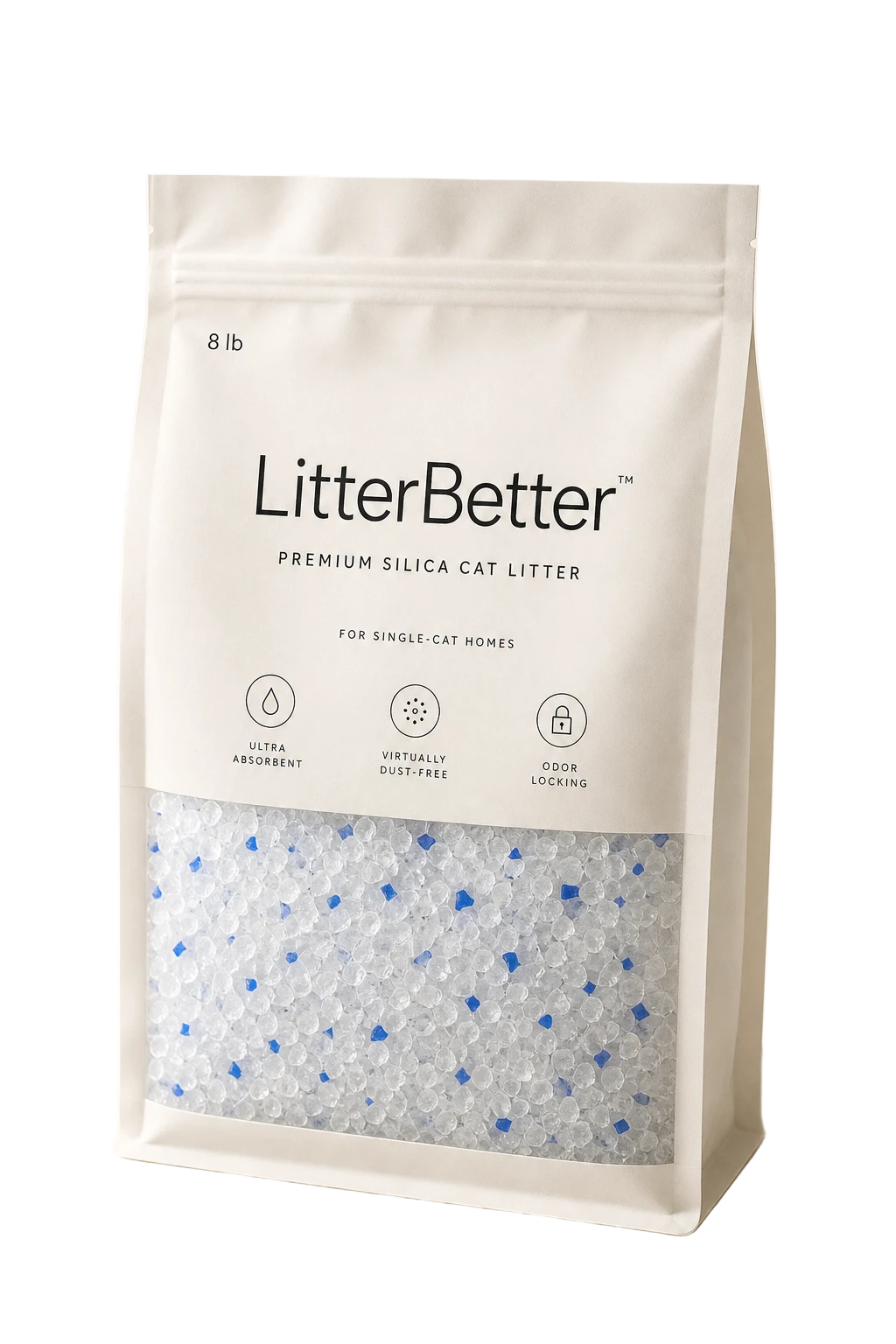
LitterBetter™ is sold in exactly those two sizes — 8 lb at $23 ($19 on subscription) and 16 lb at $38 ($32 on subscription) — so a delivery cadence maps onto a change cadence. Choose a size on the shop, or read the complete silica cat litter guide for the material behind it.
Frequently asked
- How often should you change silica cat litter?
- For one cat, replace the full bed roughly every three to four weeks. Two cats sharing a box usually need a change every two weeks. Scoop solids daily and stir every few days in between.
- Do I need to top up crystal litter between changes?
- Yes, a little. Granules leave the tray on paws and with scooped waste, so add enough every week or two to keep the bed at about two inches.
- Why is my crystal litter turning yellow?
- Saturated crystals discolour. Localised yellowing usually means the bed needs stirring; yellowing across the whole tray means the litter has reached capacity and should be replaced.
- Do the crystals dissolve or disappear?
- No. Silica gel does not break down. The granules hold water, release it as vapour, and eventually reach a point where they can no longer absorb — at which stage they are replaced, not dissolved.
Keep reading
Crystal cat litter, explained
What crystal litter is, how it differs from clay, and what to look for before you buy.
ReadOdor control cat litter that keeps rooms fresh
Where litter box smell really comes from, and the changes that actually reduce it.
ReadSilica vs clay cat litter
A side-by-side comparison, including where clay is still the better choice.
ReadThe litter
LitterBetter™
Premium silica crystals in an 8 lb pouch for one cat ($23, or $19 on subscription) and a 16 lb pouch for multi-cat homes ($38, or $32 on subscription). Free delivery, pause or cancel anytime.